Michigan Legal Milestones
The Michigan Legal Milestones program recognizes significant legal cases and personalities in Michigan's history and uses bronze plaques, placed at featured sites, to relate the historical significance. A new milestone is dedicated each year. The Legal Milestone plaques are on display across the state. Submit a nomination for a potential Michigan Legal Milestone.
The 45th Legal Milestone—The Overturned Jury
 Photo Credit: Cecil Lockard, Ann Arbor News
In 1975, at least 10 patients died at the Ann Arbor Veterans Administration Hospital after being injected with Pavulon, a powerful muscle relaxant that can be fatal in large enough doses. The FBI identified two nurses, Leonora Perez and Filipina Narciso, as the suspects and the federal case went before Judge Phillip Pratt of the United States District Court for the Eastern District of Michigan.
The ensuing trial in 1976 caught the attention of the public due to its circumstantial nature—prosecutors produced no eyewitnesses and did not offer evidence of motive in their case against the nurses—and because both nurses were Filipino immigrants.
FBI officials claimed the fast-acting nature of Pavulon and the schedules of the nurses proved they were the only two who could have administered the poison. The nurses’ defense attorney, Thomas C. O’Brien, believed the FBI targeted the two women because they were immigrants and because “the FBI had a high-profile case they could solve.” in the wake of the agency’s failure to solve the disappearance of former Teamsters boss Jimmy Hoffa in Detroit.
The story made the front page of the New York Times, was covered by CBS Evening News’s Walter Cronkite, and was also heavily covered in the Philippines, leading to a rift between the U.S. and Filipino governments.
In 1977, a jury acquitted Narciso of the one charge of murder, but Perez and Narciso were each convicted of three counts of poisoning. Later than year, however, granting a defense request, Pratt overturned the jury’s ruling and ordered a new trial—a rare occurrence following a jury verdict.
In his opinion, Pratt said the prosecution’s “persistent misconduct,” which included improprieties in arguments made during the trial as well as improper communication with witnesses, press, and jury resulted in “overwhelming prejudice to the defendants.”
Prosecutors never retried the case, and no other charges were ever filed for the murders. On February 1, 1978, the United States formally moved to dismiss all charges against both Narciso and Perez.
 (left to right): Linda Kennedy, former Chair of POEC; Pamela Wall, former Chair of POEC; Roland Hwang; Zenell Brown; Hon. Jacquelyn A. McClinton; Michael Moran; Lisa J. Hamameh, President, State Bar of Michigan
 (left to right): Clarissa Goopio, Nina McCaulley, Trine Alair, Reggie Laput, Corazon Gabarda, Thomas O'Brian, Amita Sodawalla, Michael Moran, Victoria Bryan, Martha Cabarios (back): Josie Paluay, Vicky Atilo, Annie Vista
The 44th Legal Milestone—Celebrating Percy J. Langster
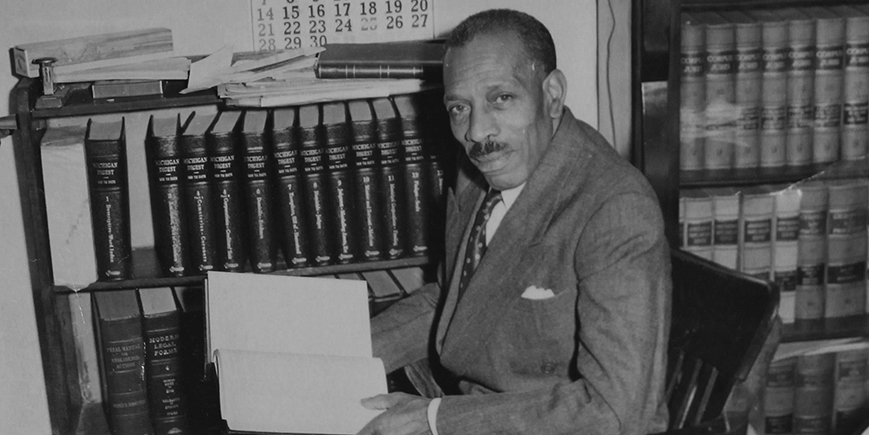
About Percy J. Langster, America’s first Black prosecuting attorney
On November 2, 1948, Percy J. Langster made political and legal history by becoming the nation’s first Black prosecuting attorney when the people of Lake County, Michigan, elected him prosecutor.
Born in 1889, Langster grew up in Oil City, Pennsylvania, the only Black child in his borough. He left school at the age of 8 to support his disabled mother. While shining shoes, young Percy listened to local lawyers share courtroom tales, which sparked his lifelong dream of being an attorney. Langster returned to school and became a star athlete and debater at Oil City High School. After graduation, he attended Cornell University on an athletic scholarship, but soon left when funds ran out. For the next 16 years, Langster saved money to return to college by working blue-collar jobs, including as a Pullman porter. Finally, in 1924, Langster entered Duquesne University, graduating eight years later at the age of 43 with both his bachelor’s and law degrees, the first Black student to receive double degrees from the university.
In 1933, Langster moved to Woodland Park, Michigan. He was admitted to the State Bar of Michigan, opened a law practice, and served as the first Black educational advisor for the Civilian Conservation Corps. During World War II, he put his practice on hold to become a technical advisor for the Army Air Corps. After the war, Langster settled in Baldwin and reopened his law practice. Langster was 59 when he ran for Lake County prosecutor, facing off against a three-term incumbent in the predominantly white county. Langster beat the odds, and the incumbent, by 152 votes.
After his victory, Langster declared: “I campaigned for justice to all and bias towards no man. And somehow, I think, the people grasped hold of that idea.”